


The Score Framework
- David Hampian

- Oct 13, 2025
- 3 min read
Updated: Oct 22, 2025
TwitchCon week always reminds me of a core truth I learned firsthand: the smartest brands don’t predict the future. They build systems that reveal where it’s going.
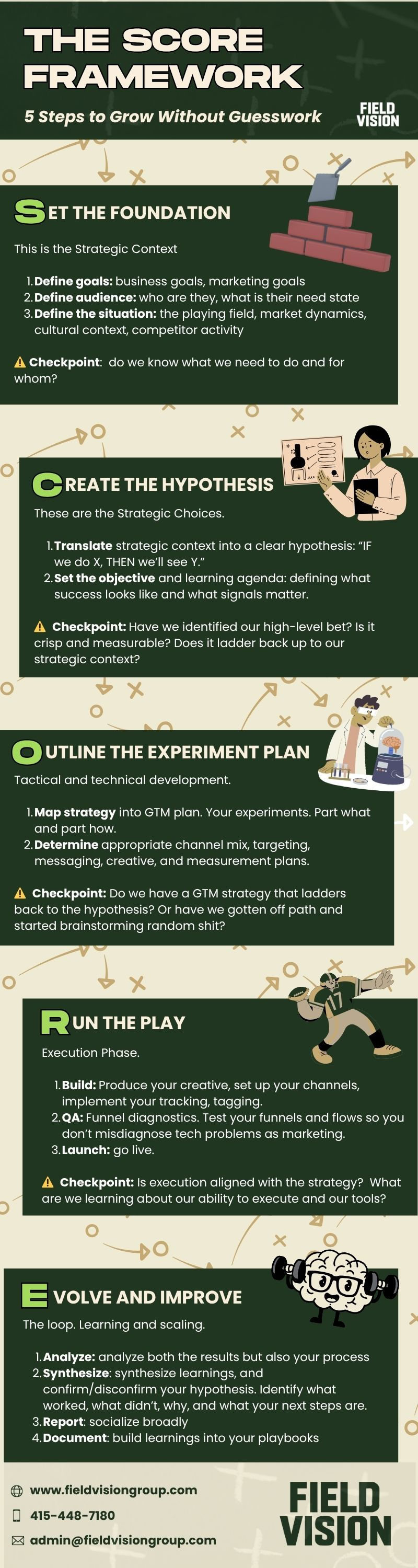
That system, for me, is called SCORE. It’s a framework I’ve created over the course of my career helping brands grow into new, emerging areas of business and audiences.
At Twitch, this new area of business was Music. Early experiments spiked, then fizzled, and nothing was sticking. SCORE became the playbook that turned chaos into clarity.
Here’s how it works:
S — Set the Foundation
This is the strategic context that is a must for any audience-led strategy. Start with your current and target customers, your brand, your business goals, etc.
For us, it unearthed that Twitch’s brand wasn’t about content; it was about community. This was different from most music streaming platforms. On Twitch, people didn’t come to just watch and listen. They came to belong.
Our mission was clear: build the music category around this truth, measured by creator growth, viewer participation, and customer retention.
C — Create the Hypothesis
Most teams skip this step. They rush to tactics and then drown in subjectivity later. Your post-mortem turns into the opinion Olympics; everyone sees what they want to see.
A crisp hypothesis anchors the work.
Ours: IF we spotlight music through Twitch’s interactivity and community, THEN we will grow music engagement on-platform.
It was simple, testable, and directional.
O — Outline the Experiment Plan
Now it was time to translate the hypothesis into an actual plan. Turn the “what” into the “how.”
Our first large-scale experiment was Stream Star: an American-Idol-for-the-Twitch-generation singing competition. Anyone could perform live, viewers could vote in real time, and the community decided who advanced and ultimately took the stage at TwitchCon for the chance to win a $20K grand prize and label-funded studio time.
Why this idea? Because it embodied our hypothesis. Competition would draw creators in and interactivity would draw viewers in. Together, this would lift the Music category’s visibility, fueling on-platform discovery and communicating that “Twitch has music (and it’s different here)”.
The flywheel would be off and spinning.
R — Run the Play
We executed in phases: open auditions, elimination rounds, and a live finale at TwitchCon Europe.
Instead of traditional brand and performance media, we amplified our own creators and made it effortless for them to market on our behalf.
When internal ideas drifted off-strategy (“Let’s add a celebrity judge!”), we pointed back to the hypothesis: Will this help us learn what we set out to learn? That discipline kept the team focused.
Millions tuned in. Thousands voted. Stream Star crowned its winner on stage in Europe. The campaign was a hit.
But success demanded a harder question.
E — Evolve and Improve
Did we actually grow the category? The data said no.
We drove awareness but not sustained creation. Engagement spiked, then normalized. Stream Star was fun, but not scalable.
So, did we fail? If I hadn’t followed SCORE, yes. Because I wouldn’t have known why. I would have been floating in uncertainty, guessing.
But because I did follow SCORE, I had clear data, signals, and learnings for what to do next. And I wasn't guessing. I had certainty.
It was a format issue. Creators found that singing live, on-stream, with their communities was too labor intensive compared to other content formats. It was a lot of work and tiring. And if you didn’t have your audio dialed in, it was a bad experience. It was hard to do this often; they needed lighter, more repeatable formats.
Which led us to our new hypothesis. But that's a story for another time.
The Takeaway
You don’t get ahead of culture through guesswork. You get ahead through systems that reveal where it’s going.
SCORE gave us a way to see patterns early, act with precision, and evolve faster than instinct alone ever could.
It’s growth without guesswork.
You can download the SCORE framework for free. If you use it, let me know how it goes. I’d love to hear what it reveals for you.
DOWNLOAD HERE:


Comments